
Know someone who’d enjoy The Craft of LBM Sales Newsletter?
Forward this to them so they can subscribe here—and never miss a Thursday edition packed with practical sales insights

Summer 2011.
I was a purchasing manager at Pulte Homes.
I barged into the office of my colleague, Andrew Cooper, after realizing something about myself.
“You ever find yourself negotiating the hell out of every last nickel until the project is awarded, and then watch yourself flip off the negotiation switch completely?”
Now, if Spock and Martha Stewart had a lovechild, it would be Andrew Cooper.
Home building savant.
Better social skills.
Better style.
His idea of fun is hunting mispriced BMW wheels on eBay and arbitraging them out of his garage.
He stared at me.
“Go on.”
So, I explained how I had surprised myself. For two weeks our team had been hammering out contracts for a new community.
Every linear foot of base shoe was negotiated.
Every metal alloy of door stopper debated.
Friday afternoon the bids were awarded.
Then, Monday morning we had a change.
Talk to the suppliers and subs. Get it included, we were told.
And what do I do?
I send an email.
No phone call.
No negotiation.
Just: “Gimme a number and I’ll throw it in the contract.”
“That’s odd, right, Coop?”
“It’s called price sensitivity,” he said. “Last week you were negotiating. This week you’re executing. Those are two different mindsets. Most humans can’t stay in negotiation mode forever.”
“But I wasn’t even aware I was doing that,” I said.
“Yeah, well, you should be. It’s your job. Close the door on the way out. I’m hard-bidding the exact quantity of peas in the gravel per square foot of concrete.”
During bidding, every dollar matters.
Every line item gets questioned.
Every supplier is asked to sharpen their pencil.
Then the contract is awarded.
And overnight the conversation changes.
Instead of asking, “Can you drop $1.21 off every 2/8 door?” the question becomes “What does this change add to the contract?” and eventually, “Charge me whatever the hell you want. We got framers waiting on the job right now!”
This is what I call The Price Sensitivity Trap.
Take a look at the graph below.
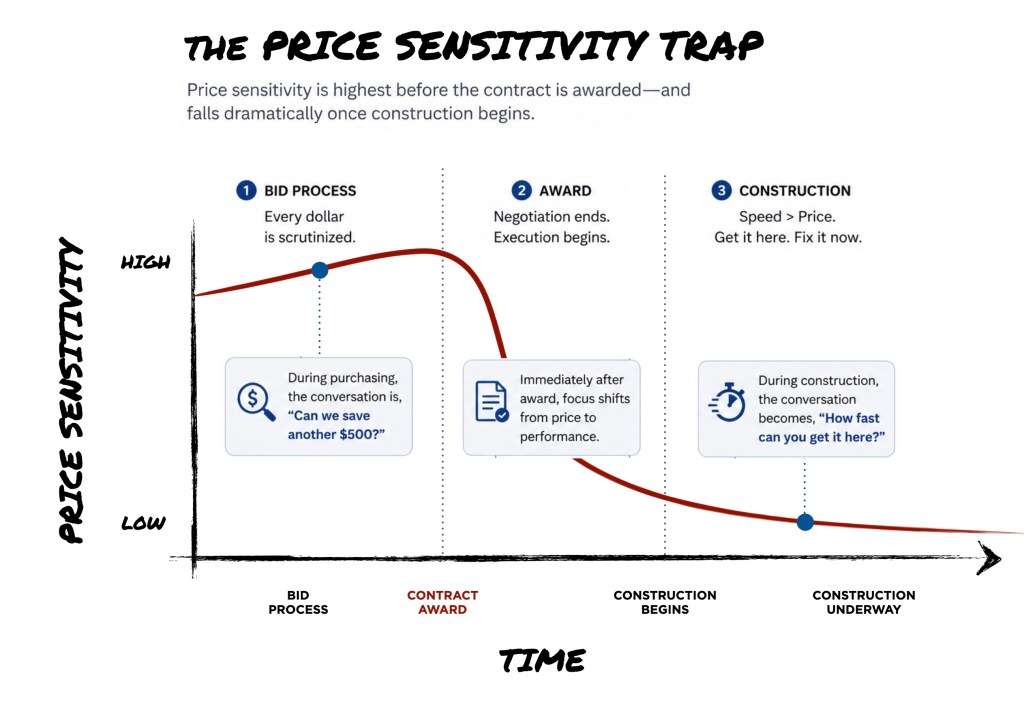
During the bid process, price sensitivity is high.
Home building carries a ton of risk and endless complexity, so it makes sense to protect margins and make smart buying decisions.
Once the contract is awarded, everyone’s attention shifts to the next project.
Price sensitivity drops.
And once construction begins, price sensitivity plummets.
The schedule on that job becomes the priority.
The framer is waiting.
The inspector wants the doorbell replaced.
The homeowner wants to move up the closing date.
Every hour of delay adds costs that weren’t even under consideration during the bidding process.
Price still matters.
But it’s not the first question anymore.
This creates a blind spot.
And some suppliers understand this dynamic well—and exploit it.
Appear to be the low bidder.
Win the work.
Recover margin later.
Let urgency replace negotiation.
These suppliers understand something crucial many builders ignore: The most expensive decisions on a project often get made after everyone stops negotiating.
The pressure cooker environment that is home building will result in a call that sounds like this: “Do whatever you gotta do, just get it out to the site as fast as possible!”
Every builder has experienced this.
Few have ever seen it illustrated.
One clarification: I know that not every change order is avoidable. Construction is complicated. Owners change their minds. Plans get updated. I get it. The trap is when avoidable surprises become part of the pricing strategy.
This is why every LBM salesperson should do two things.

ONE
Schedule a 20-minute, face-to-face meeting with the decision-maker before you ever begin the takeoff.
Up front.
Weeks ahead of time.
Use those twenty minutes to explain the assumptions behind your proposal, the recommendations you’ve made, and any opportunities to improve the plans before construction begins.
When this face-to-face meeting is scheduled weeks in advance, everyone benefits.
For a purchasing manager, saying yes to a 20-minute meeting three weeks in advance is like agreeing to a meeting in 2034.
Yeah, sure. Whatever. That’s a lifetime away given the pile of work on my desk right now.
Ask for twenty minutes the afternoon the bids are due?
Forget it.
Might as well ask for a kidney too.
Listen to this week’s Craft of LBM Sales Podcast with Erin Stetzer for a builder’s perspective on this idea.
TWO
Explain the Price Sensitivity Trap.
Walk them through the graph.
Ask if they recognize it.
Then be quiet.
Their reaction will tell you a lot about how they think.
Some will immediately start telling stories about projects where the “low bid” became the most expensive bid. Others will dismiss it.
Either response will teach you something about how they buy, what they value, and whether they’re interested in getting it right the first time—or just a low number.
At Pulte, we talked constantly about Total Cost of Ownership.
Not just the contract.
What happens in the field.
The details in the warranty.
The homeowner experience.
Everything.
The best builders understand that the lowest total cost of building a home—and providing a warranty on it—is different from the lowest number on page sixteen of the proposal.
It took me years to recognize that pattern in myself.
Your customers may never recognize it unless you point it out.
So, schedule the meeting.
Teach the Price Sensitivity Trap.
Then pay attention.
You’ll learn a lot about your customer.
And they just might learn something about themselves.
Thanks for reading.
I’ll see you back here next week.


The only podcast built for LBM sales leaders and reps.
The Craft of LBM Sales Podcast delivers practical sales coaching you can use immediately—anytime, anywhere.
Subscribe here:
Apple Podcasts | Spotify
Copyright © 2026
Bradley Hartmann & Co.
All rights reserved.

Contact Bradley Hartmann:
bradley@bradleyhartmannandco.com

