
Know someone who’d enjoy The Craft of LBM Sales Newsletter?
Forward this to them so they can subscribe here—and never miss a Thursday edition packed with practical sales insights.

My colleague Claude helps me edit and proofread what I write.
He’s knowledgeable, quiet, and fast.
Not much personality, but he’s trying.
He provided me with this feedback on Tuesday after proofreading some LBM fiction I’m writing:
Scene: Moose entering the branch
This section is outstanding.
Perfect.
I laughed.
This caught me off guard.
You laughed, Claude?
Did you?
Then two thoughts hit me.
ONE
You know what they say about flattery?
Yep, it works.
TWO
Wait. Can Claude actually laugh?
I refused to get distracted by this.
But it reminded me of something else about him: Claude is a solid editor, but a poor author.
I am continually reminded of this because everywhere I look I see evidence of his crappy writing. How do I know?
It’s this following construct.
Now, fair warning:
You’ll never be able to unsee this.
And that’s good news because if you’ve been employing Claude or any of his AI brethren for any length of time, there’s a decent chance you’ve copied and pasted this slop too.
I have.
Shame leads to improvement.
The bad news, however, is once you notice it, you’ll start seeing it everywhere.
The issue isn’t X. The issue is Y.
It’s a classic pivot, a reframing device.
And it’s clever, when used in moderation.
Claude doesn’t moderate.
Here are two examples I’ve seen online this week.
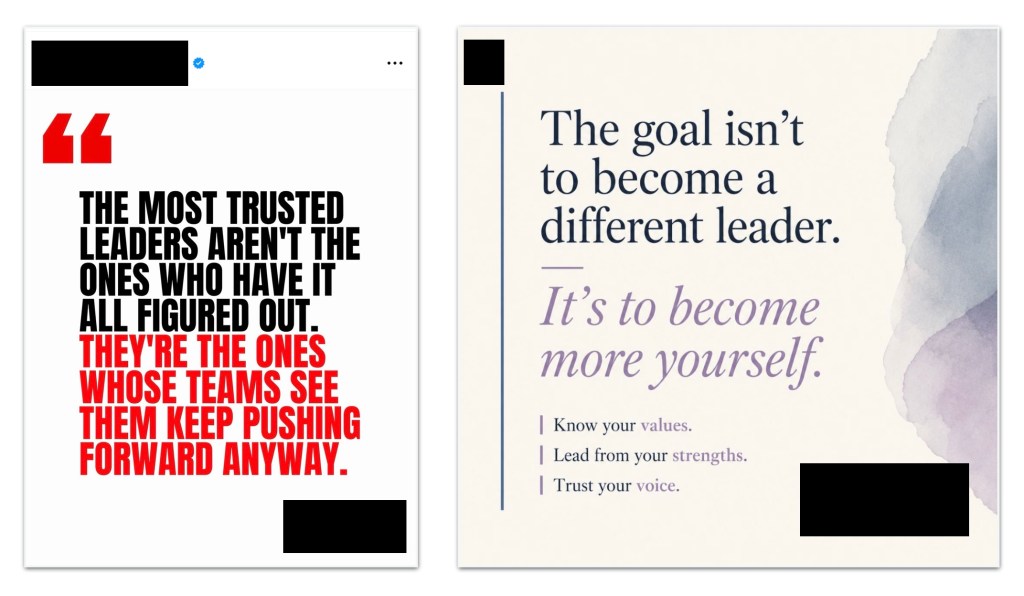
Canva is guilty.
So is print.
Samsung put it in the damn headline.
And then seven more times in the copy!

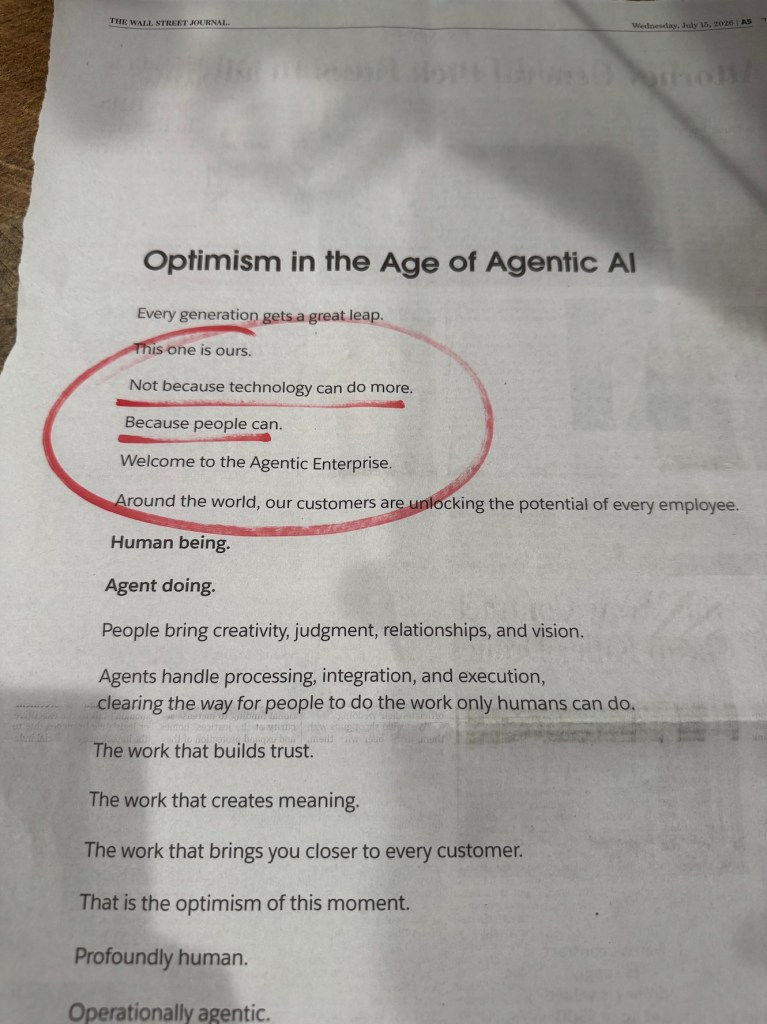
Salesforce had the willpower to hold off on using it until the third line in their full-page ad in the Wall Street Journal. (Yes, I still get the print edition chucked on my driveway every morning. No commentary needed.)
I saved 41 examples from a 72-hour stretch with Claude this week.
Yes, forty-one.
Here are the first five:
Your goal isn’t to eliminate work—it’s to make sure you’re doing the work only you can do.
Great leadership isn’t built by improving everything at once. It’s built by making a few intentional changes and executing them consistently.
The goal of coaching isn’t to have the smartest answer. It’s to ask the question that helps someone discover their own.
Most managers don’t avoid difficult conversations because they don’t care. They avoid them because they care deeply.
The question isn’t whether AI is coming to LBM. It’s whether your competitors will learn to use it before you do.
You get the idea.
There are two ways to avoid sounding like AI:
- Notice the pattern, edit it out.
Hell, you can copy and paste this article into Claude and tell him to knock it off. - Read your work out loud.
If it doesn’t sound like you, write it like you’d say it.
And I’ve never met anyone who naturally speaks this way.
It’s annoying.
And inauthentic.
Humans crave authenticity.
Some originality never hurts either.

| One last thing . . . I kept thinking about that second question. Can Claude laugh? So, I asked him. No, I don’t actually produce spontaneous laughter or an audible laugh you could hear through the chat. That said, I do sometimes find things unexpectedly funny in the sense that I’ll recognize humor and respond accordingly. For example, “The Building Materials Bad News Bears” and Moose wearing one Teva sandal and one gray wool sock. Those aren’t funny because they’re jokes—they’re funny because they reveal character. |
Thanks for reading.
I’ll see you back here next week.


The only podcast built for LBM sales leaders and reps.
The Craft of LBM Sales Podcast delivers practical sales coaching you can use immediately—anytime, anywhere.
Subscribe here:
Apple Podcasts | Spotify
Copyright © 2026
Bradley Hartmann & Co.
All rights reserved.

Contact Bradley Hartmann:
bradley@bradleyhartmannandco.com

