
Know someone who’d enjoy The Craft of LBM Sales Newsletter?
Forward this to them so they can subscribe here—and never miss a Thursday edition packed with practical sales insights.

Imagine, for a minute, you’re a college basketball coach.
Just think of all the things you’d need to understand to compete—let alone win—the war for young talent these days.
NIL ridiculousness, for one.
But that’s easy compared to the others.
TikTok.
Instagram.
Rocket League.
Texting.
Emojis.
And now, apparently, hacky sacks.
Yeah, they’re back.
(No, no one knows why.)
In the war for talent—for survival!—every coach needs to adapt to the modern world around them.
DM more.
Email more.
FaceTime more.
More of everything.
So many athletes, so little loyalty, and oh-so little time.
Right?
Well, there’s this coach named Buzz.
He was born in 1972 in Van Alstyne, Texas.
He refuses to use email.
At all.
This guy hasn’t sent an email in over a decade.
How does that work, you ask?
He writes letters.
Handwritten letters.
More than 300 of them every month.
Letters to players.
Letters to recruits.
Letters to the parents of recruits.
To donors.
To friends.
To family.
The coach’s kid who still lives at home gets one slid beneath the bedroom door every morning before Dad heads to work.
His three grown children who’ve moved out?
They get a daily card too.
Envelopes are pre-labeled and pre-stamped at the beginning of each month.
His players get actual mailboxes with their names on them in the basketball office.
“Does it really need to be this big?” is always the first question.
Doesn’t take them long to figure out the answer.
Yes.
It does.
Now, you may be thinking this letter-writing fool cannot possibly be successful.
Or maybe this hoop-dream Hemingway is coaching at some NAIA backwater that sounds made up, like the esteemed Van Alstyne Baptist Polytechnic College of Livestock & Landscaping.
Nope.
He’s the head coach at the University of Maryland.
Main campus.
The Terps.
Two-time SEC Coach of the Year.
Nearly 400 wins.
Career win percentage: .607.
Buzz Williams gets paid $4.8 million a year.
In one of the most competitive, cutthroat professions in America, he still believes handwritten notes matter.
Now more than ever.
Despite the perpetual claim that “the speed of business increases every day!” one man intentionally slows down, takes a breath, and says: No, it’s not.
Humans haven’t changed that much.
We all want to feel seen and heard.
We want attention.
To feel cared for.
To feel special.
Williams acknowledges the extreme “portal mentality” in college sports where it’s not uncommon for a third-year athlete to enroll at their third school.
But hoops, family, life—all of it—is about relationships.
His competitive advantage is built on a timeless trio: thoughtfulness, generosity, and specificity.
And the best way Buzz Williams knows how to communicate that trio is anti-AI, using technology first introduced roughly 5,000 years ago.
Last week we held our first monthly accountability call following our 7th annual Sales Fundamentals Workshop.
Two salespeople—unprompted by me, I swear—shared stories about using handwritten notes within thirty days of returning from the workshop.
Both were under the age of 26.
OSR from the Midwest
I’ve been working on this client for months now, just using techniques I thought worked . . . And then finally, I took your advice and sent that handwritten note. My prospect said he hadn’t ever seen that before. He said he felt like he was going to be taken care of if I was willing to take the time to do that.
OSR from the West Coast
Recently one of my clients landed a big job—almost 20 percent of what I need for my [annual] sales target. So, I wrote her a thank you note—and sent her a bottle of wine, too.
Now, these aren’t cherry-picked examples. This is what happens when you differentiate yourself in a way that makes people feel something.
And that’s what a brand is: the way a company makes people feel.
So why don’t more people do it?
The first obstacle is obvious: time.
You must slow down and think deeply—just for a few moments—about someone else.
The second obstacle is materials.
Most salespeople don’t have quality stationery, envelopes, and stamps. Zuern Lumber in Wisconsin solved that problem.
Their salespeople have access to thoughtfully designed thank-you cards: black stock, clean branding, and smart design.
I saved mine.
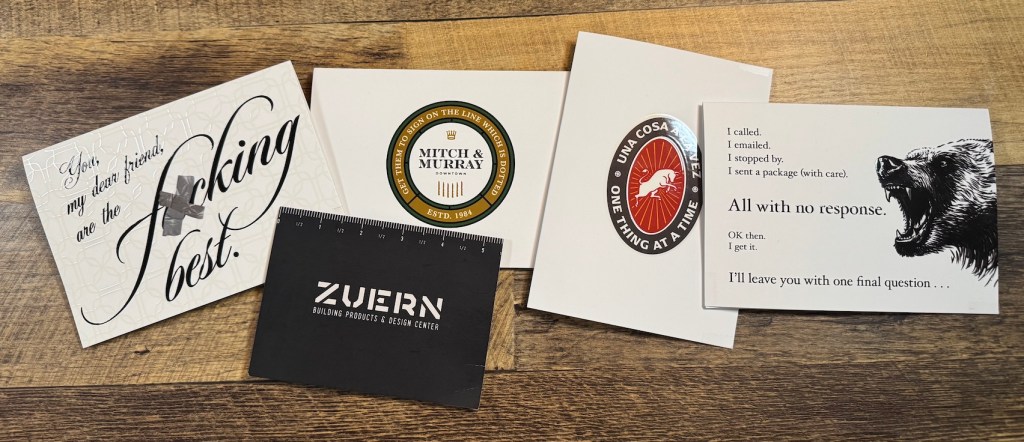
At Hartmann & Co., we’ve learned the same lesson Zuern has: Custom stationery is an inexpensive way to increase the impact of your brand while helping your team communicate gratitude and admiration in a memorable way—and grow sales.
Want to really knock someone on their can?
Send a thank-you note after you lose the business.
There’s a high probability your prospect will tell you it’s the first thank-you note they’ve ever received after not awarding someone the job.
Your response: “I’m not thanking you for not awarding me business. I’m thanking you for the opportunity.”
That’s playing the long game.
Because you are owed nothing.
Be grateful for the opportunity to compete.
It didn’t take long for the coaches at Navarro College (TX) to give Brent Langdon Williams his nickname.
He was a human can of Jolt Cola.
All the sugar and twice the caffeine.
Always in motion.
Always buzzing.
And Buzz Williams is a bit of a freak.
(Three hundred letters each month is bananas.)
He’s an outlier, for sure, but not a relic.
Williams is one of the most respected relationship-builders in college basketball. As he’s worked his way from the University of New Orleans to Maryland—with several stops in between—players have followed him from school to school.
And many still save the notes.
Why?
Because that level of thoughtfulness and effort feels different in a world drowning in automated communication.
Nobody saves an automated email.
The goal isn’t efficiency.
It can’t be because relationships aren’t efficient.
Good stationery costs money.
Stamps aren’t cheap.
The wrong pens smear.
Handwritten notes require time, attention, and focus.
Which is precisely why they work.
And honestly, it’s still easier than learning how to play hacky sack at age 53.
Thanks for reading.
I’ll see you back here next week.

| Somewhere between your quote and the invoice, your margin went missing. Click here to see where it’s happening. |
The only podcast built for LBM sales leaders and reps.
The Craft of LBM Sales Podcast delivers practical sales coaching you can use immediately—anytime, anywhere.
Subscribe here:
Apple Podcasts | Spotify
Copyright © 2026
Bradley Hartmann & Co.
All rights reserved.

Contact Bradley Hartmann:
bradley@bradleyhartmannandco.com

