
Question: How worried do I need to be about this Brad Jacobs thing? Am I delusional to think that I will just adapt to whatever he does to the industry and use it to my advantage?
— Chris, a multi-location LBM owner in the Midwest
Answer: Hi Chris, on the Jacobs Roll-Up Apocalypse Meter (JRAM), you should be at a 14 out of 100.
No food rationing needed.
No need to engage in bunker building.
And no, you’re not delusional.
But let me tell you what you should be: optimistically paranoid.
Every morning, I swing my legs out of bed, curl my toes into the carpet, and say, “Today is going to be a great day.” Then I remind myself that any success I’ve achieved to date can disappear in an instant—and that I’d better work with a sense of urgency, expect nothing, and deliver value first.
That’s optimistic paranoia.
It’s not fear.
It’s fuel.
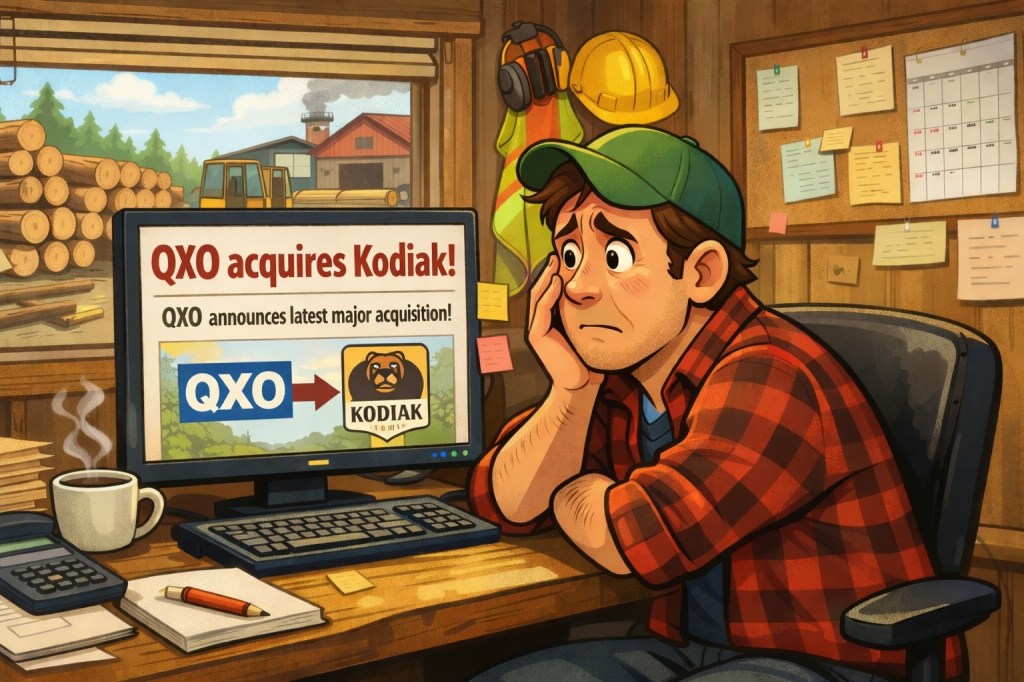
And right now, QXO can be excellent fuel.
Use every competitor.
Each one forces urgency and clarity.
Each one can drive improvement.
Whether you’re thinking about BFS, US LBM, QXO, or any other combination of letters competing in your market, optimistic paranoia is a far better stance than comfortable complacency.
If you’ve read Jacobs’ How to Make a Few Billion Dollars, you know his playbook is based on disciplined execution, not magic.
Yours should be similar:
• Communicate a vivid vision.
• Build a hungry, pro-sales culture.
• Tie incentives directly to new sales.
• Encourage experimentation, especially with AI.
• Be fanatical about helping your customers make, find, and save money.
If you’re already doing those things, congratulations.
Keep it up.
If your vision is muddy, your incentives are misaligned, your culture is heavily operations-driven, and you think “AI experimentation” means asking ChatGPT where to get lunch, your JRAM should be closer to a 57.
But even then, the response isn’t fear.
It’s positioning.
Where are you and QXO positioned in your market?
Ask the next sales rep that walks by this question: How do you position us within our market?
If his answer sounds like this: “Oh, well, we’re honest, hardworking people with three locations who’ve been in business for 99 years, selling high-quality products at a fair price, on time and in full…”
You’ve failed this portion of the exam.
Not because it’s untrue.
But because everyone says it.
(Yes, even QXO can claim to be a legacy brand; Beacon was founded in 1928.)
And if it’s what everyone says, it is, by definition, undifferentiated.
Differentiation isn’t about what you say about yourself.
It’s about the contrast you create in the customer’s mind.
So you must define that contrast before QXO defines it for you.
Here’s what it can sound like:
QXO raises capital from—and answers to—global investors to fuel their growth.
We grow when it strengthens our people and better serves our customers, not because a capital plan demands it.
QXO must manage to quarterly earnings expectations.
We manage for long-term relationships and the next generation.
QXO is a brand created in a boardroom.
Ours was built right here, over generations.
These aren’t attacks.
They’re positioning contrasts.
You’re not trying to convince customers that QXO is bad. You’re helping customers determine what they value—before a QXO sales rep walks in and does it first.
Start right here, right now.
Write down the one thing your best customer would say about you that QXO could never say.
One sentence.
If you can’t write it in under 60 seconds, that’s your real problem—not Brad Jacobs.
And if you want to go deeper, buy a copy of Positioning: The Battle for Your Mind by Al Ries and Jack Trout for every leader in your company.
Brad Jacobs has said he studied dozens of industries before launching QXO and ultimately chose building products distribution because it “checked every single box”— fragmentation, inefficiency, low technology adoption. A sector ripe for consolidation.
That’s not an insult.
It’s his strategy.
In the QXO press release announcing their Kodiak acquisition, CEO Steve Swinney said, “QXO is the most exciting company in the industry.”
Good.
Let that excitement drive your urgency. Let their capital and scale remind you what you have that they don’t.
Let their ambition sharpen yours.
If QXO wants to be the Goliath in this story, well, you know how it ends.
But David didn’t win by worrying.
He won because he knew exactly who he was—and used it.
Sharpen your story.
Align your incentives.
Commit to AI leadership now.
Position your company where it belongs.
Optimistic paranoia beats comfortable complacency every time.
Thanks for reading.
I’ll see you back here next Thursday.
Thanks for reading.
I’ll see you back here next Thursday.
Subscribe here to get the next edition of The Craft of LBM Sales straight to your inbox—weekly stories and practical advice to master the craft of selling.
Want the straight analysis on QXO’s Kodiak acquisition and what it means for your sales team in 2026?
Jon Vaughan and I break it down in Episode 44 of The Craft of LBM Sales Podcast.
Listen here:
Apple Podcasts | Spotify
Copyright © 2026
Bradley Hartmann & Co.
All rights reserved.
Contact Bradley Hartmann:
bradley@bradleyhartmannandco.com
 The Craft of LBM Sales