

“When you ask a professional for their take on your material, you’re not just asking them to take an hour or two out of their life, you’re asking them to give you—gratis—the acquired knowledge, insight, and skill of years of work. It is no different than asking your friend, the house painter, to paint your living room during his off-hours.”
Josh Olson, the Academy Award-nominated screenwriter, wrote that in his 2009 rant titled I Will Not Read Your F%!ing Script.
As you can guess from his title, Josh was frustrated by a request to read a screenplay.
And Josh is like most people: He wants to be useful and he wants to be liked.
That resonates with me.
Deliver value first, I say.
But we need to be careful because there’s a paradox here.
If we’re not selfish with our time, other people will use it to pursue their goals—leaving us with little time to pursue our own.
I’ve even got a sign on my office wall to remind me of this.
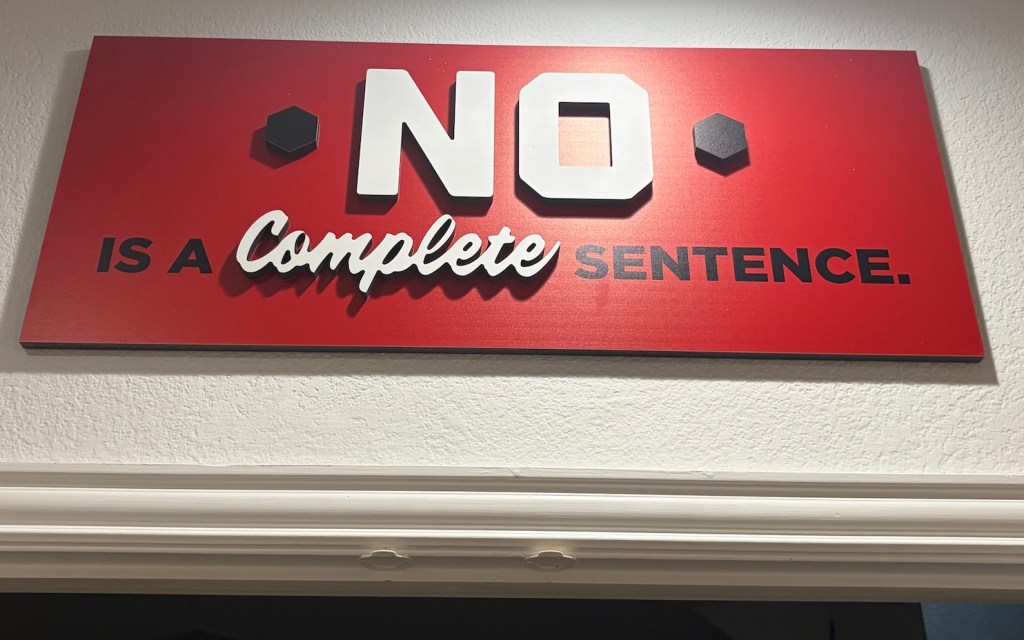
And I’m still terrible at it.
I’m hardly alone.
A sales pro in Michigan sent me this email last week:
“As I say ‘no’ less and less, and more people come to me, it’s getting harder to manage my time. If I don’t stick to my system every single day, it falls apart. The days, weeks, and months just fly by. How do you confidently say no?”
He’s not struggling with discipline.
He’s struggling to navigate around a trap.
The Trap
You want to be useful.
The one customers trust.
The one your team relies on.
And that feels good for a while.
And then it doesn’t.
Because over time, “being super helpful” turns into “just call [your name here]. They’ll handle it for you.”
Your to-do list expands.
The pressure builds.
The sticky notes multiply.
Commitments are misplaced.
Deadlines are missed.
You find yourself apologizing more and more.
You’re working harder than ever, but are you advancing toward your goals?
The Olson Test
Here’s how Josh opens his essay:
“I will not read your script. What’s not clear about that? There’s nothing personal about it, nothing loaded, nothing complicated. I simply have no interest in reading your screenplay. None whatsoever.
“If that seems unfair, I’ll make you a deal. In return for you not asking me to read your script, I will not ask you to wash my car, or take my picture, or represent me in court, or take out my gall bladder, or whatever it is that you do for a living.”
(Programming note: I removed eight f-words from that quote. Where I come from, F stands for family.)
Every profession has its own version of this request.
Especially sales.
We let people treat our time—and our judgment—as if every day is wide open for fishing, golf, and bourbon.
Time Is Your Inventory
In LBM sales, your constraint isn’t builders.
Or bids.
Or backorders.
It’s time.
Olson tells a story about Pablo Picasso.
A man saw the legendary artist in a cafe. He offered to pay him to draw a picture on a napkin.
In a flurry, Picasso whipped out a marker and sketched something abstract. He then took it in his hand, extended it toward this patron of the arts, and said: “One million dollars, please.”
“A million dollars? That only took you thirty seconds!”
“Yes,” said Picasso. “But it took me fifty years to learn how to draw that in thirty seconds.”
Your customers aren’t just paying for your time. They’re paying for everything you’ve learned throughout your career in this industry—the relationships, the counterintuitive insights, the hard-earned judgment.
That’s your value.
And delivering that value takes time.
If you don’t allocate your time intentionally, someone else will.
That doesn’t mean you stop helping people.
It means you choose where you help.
Helping coworker Chris who refuses to learn the new ERP system?
That’s not being a good teammate.
It’s enablement.
That’s you, throwing a collegial arm around what’s known as learned helplessness.
So what’s the goal?
It’s not to say no to everything.
The goal is to say no with purpose.
Before you agree to something, ask:
• Does this help my customers win?
• Does this move a deal forward?
• Is someone else being paid to do this?
If the answer is no—well, your answer should be no.
And it doesn’t need to be complicated.
“No, I don’t have the bandwidth for that right now.”
That’s it.
No need to rant.
You need your energy for your goals—for intentional prospecting and proactive planning and going on offense against your bigger competitors.
Selling, that is.
You need your time for selling.
Because no one else defaults to selling.
If you don’t do it, layoffs will happen.
Harsh, but true.
No is a complete sentence.
Start treating it like one.
Thanks for reading.
I’ll see you back here next week.
Subscribe here to get the next edition of The Craft of LBM Sales straight to your inbox—weekly stories and practical advice to master the craft of selling.

The only podcast built for LBM sales leaders and reps.
The Craft of LBM Sales Podcast delivers practical sales coaching you can use immediately—anytime, anywhere.
Subscribe here:
Apple Podcasts | Spotify
Copyright © 2026
Bradley Hartmann & Co.
All rights reserved.

Contact Bradley Hartmann:
bradley@bradleyhartmannandco.com

