

Reader mailbag question from Brandon, a young salesperson in the Midwest.
“Hey Bradley, I attended your workshop earlier this year and started tracking my time. I realized over 70% is spent on non-sales activities. As of today, I’m behind pace by 17%. I asked my manager if we could hire an inside sales coordinator to free up my time, but he said no. Any suggestions on what to do next?”
Brandon: great question.
Before we go any further, take a second and give yourself some credit. Tracking your time like that takes discipline, which is exactly why most reps don’t do it.
Now, about your ask.
I strongly encourage sales professionals to ask for what they want.
That isn’t the issue here.
Your issue is that you made a big ask without a business case.
“Hey boss, if I didn’t have to do all this paperwork, I could sell more.”
At best, it’s vague.
At worst, it sounds like whining.
What it’s not is a business case.
You don’t need an MBA to build one.
You just need this simple framework: PRICE.
The PRICE framework
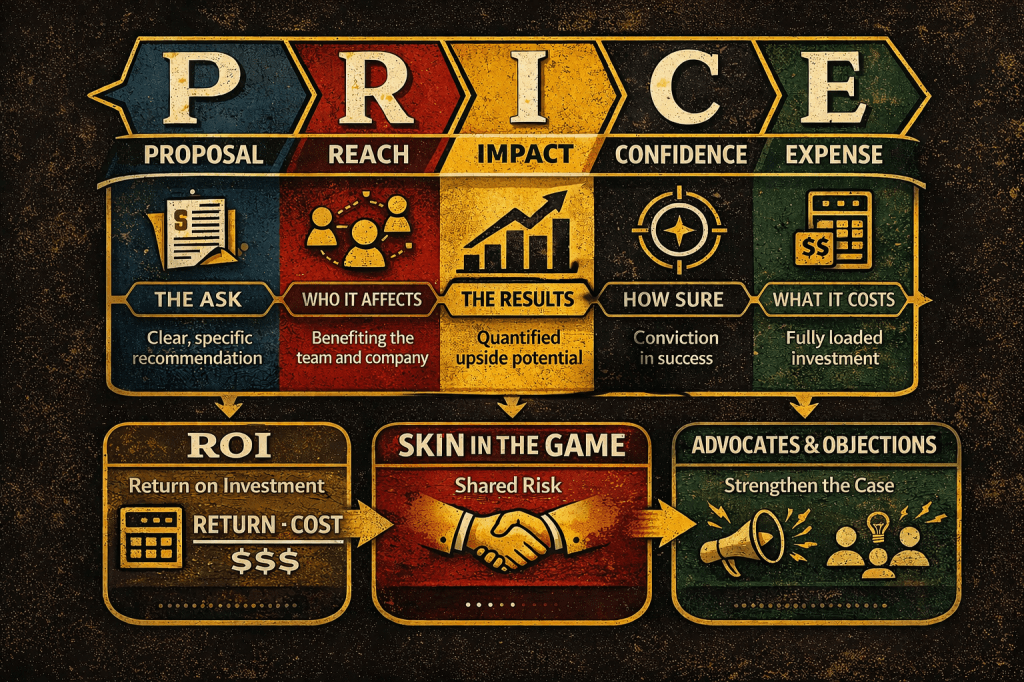
P: Proposal
Start with clarity.
The simplest way to structure your ask:
What you want + three supporting reasons
“I believe hiring an inside sales coordinator will generate a strong return for the company because it will allow me to convert more non-customers into customers, expand the number of product categories I sell to existing customers, and spend more time face-to-face with builders on job sites.”
If your manager has to guess what you want, you’ve already lost.
Remove the ambiguity.
Be specific.
R: Reach
Who does this impact?
This is where you shift from what I want to how this helps us win.
“This wouldn’t just impact me. It would help the company grow revenue and margin, take market share, and create a better experience for our customers through faster response times and more proactive engagement.”
Now it’s not merely self-interest, it’s alignment with the company’s goals.
I: Impact
This is where most people fall short.
They hint at the upside but never quantify it.
“Right now, I’m spending about three hours per day on two non-selling activities: data entry and order processing. If I can reclaim that time, that equates to roughly 15 additional selling weeks per year.”
Then translate that into dollars.
“If I convert that time into selling activity, I believe I can generate an additional $1.25 million in revenue at approximately 28% gross margin—about $350,000 in gross profit.”
C: Confidence
Put a stake in the ground.
“Based on my current pipeline and the opportunities I’m not pursuing today, I’m 85% confident this is achievable.”
No one expects a guarantee.
They do expect conviction.
E: Expense
What does this actually cost?
“I estimate the fully loaded cost of an inside sales coordinator to be around $92,500 per year.”
People are expensive—and good managers know it goes well beyond salary.
Now, doing all this work puts you ahead of most sales reps.
But if you want to make this genuinely hard to say no to, keep going.
ROI
Convert the request into an investment.
“If we compare $350,000 in potential gross profit to a $92,500 investment, that’s nearly a 4-to-1 return in Year One—and that return should grow while the cost stays relatively fixed.”
Skin In the Game
Here’s the move most people won’t make—but it’s the one that changes everything.
Your boss knows something you didn’t say out loud:
You get most of the upside.
The company takes most of the risk.
So flip it.
“To show how strongly I believe in this, I’m willing to put some skin in the game. If this doesn’t perform as expected, I’m open to temporarily reducing a portion of my commissions to help offset the cost. If it does perform, we can revisit that once the results are proven.”
Now this isn’t a request.
It’s a shared bet.
Advocates
Before you present, run it by a few respected colleagues.
“I’ve already run this by Sam in Finance, Chris in Credit, and Terry at the Springfield location. They offered feedback—which I’ve incorporated—and they encouraged me to bring this to you.”
Now your business case has backers.
Objections
Sales runs on objections.
Anticipate them—and answer them before they’re raised.
Include a short FAQ in your proposal:
What if the volume doesn’t materialize?
I’ll revisit the commission offset arrangement at the 90-day mark.
What if the role isn’t fully utilized?
I’ve outlined three specific responsibilities beyond pipeline support to keep this role productive from Day One.
What if margins decline?
The proposal is built on conservative margin assumptions; I’ve shown what this looks like at 24% as well.
If you handle objections before they’re raised, you control the conversation.
The bigger picture
This isn’t just about hiring a coordinator.
It’s about how you think—and sell.
Very few people are willing to do the work to define a problem, quantify it, and present it as a business case.
Anyone can curse the darkness.
With the PRICE framework, you’re lighting a candle.
This is the difference between a typical salesperson and someone worth investing in.
And if this feels like a lot of work, well, that’s the point.
Most won’t do it.
That’s exactly why you should, Brandon.
Thanks for reading.
I’ll be back next week.

Subscribe here to get the next edition of The Craft of LBM Sales straight to your inbox—weekly stories and practical advice to master the craft of selling.

The only podcast built for LBM sales leaders and reps.
The Craft of LBM Sales Podcast delivers practical sales coaching you can use immediately—anytime, anywhere.
Subscribe here:
Apple Podcasts | Spotify
Copyright © 2026
Bradley Hartmann & Co.
All rights reserved.

Contact Bradley Hartmann:
bradley@bradleyhartmannandco.com
 The Craft of LBM Sales