

Imagine a Toyota Sequoia. It’s like a 4Runner on steroids—seventeen feet long, nearly seven feet wide, weighing 5,600 pounds, and as tall as an NBA point guard.
Now imagine something bigger.
Faster.
A predator shaped by millions of years of evolution, slicing through saltwater at speeds that would embarrass Usain Bolt.
What I’m asking you to picture is an apex predator: A female great white shark.
Marine biologists don’t want to imagine what this shark does all day—they want to know. But they can’t study it from the shore, with a drone, or even from a boat.
To understand its behavior, they have to tag it.
Physically.
Sales leaders interested in the science of sales success face a similar problem. They see the lag measures: quotes, orders, and revenue. They hear compliments from customers. But the lead measures—the behaviors that create those outcomes—remain hidden.
So, my team and I did what marine biologists do: We tagged a shark.
We found a top LBM sales hunter who agreed to let us study him for 30 days. (Yes, he is a saint. But he agreed to this for selfish reasons: “I’m always trying to get better. I know I’ll learn something here that will help me improve.”)
Before the month began, we interviewed him for three hours, analyzed his pipeline, and documented his sales forecasts by account.
During the month, we tracked every call, email, text, mile driven, and customer interaction. Every Friday, we interviewed him again to understand why he made the choices he did.
In honor of the captain in Jaws, we’ll call this LBM sales pro Quint.
He’s 30 years old, a former high school athlete with a bachelor’s degree.
Nothing about his résumé predicts elite performance. Any stereotype of the prima donna sales rep disappears within minutes. Self-deprecation is his default: “I’m just a dumb old country boy trying to make some business sense.”
And yet, in one month, Quint generated $1.7 million in revenue—exceeding his goal by 31 percent. Beneath the surface, five patterns explained how he did it.

1. Relentless Communication Is a Strategy
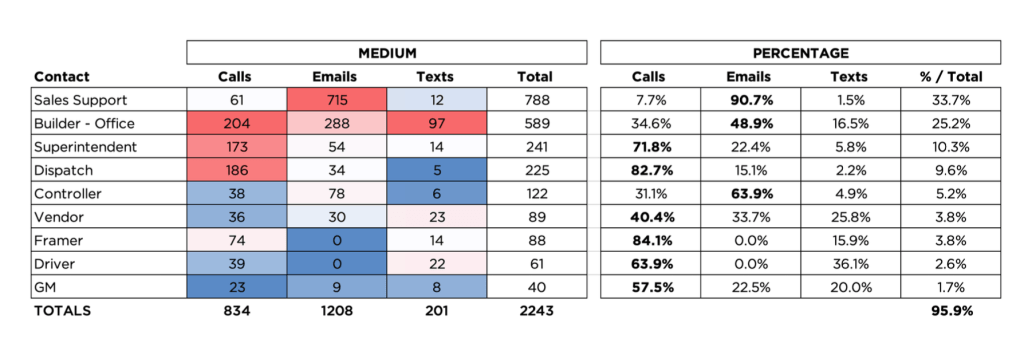
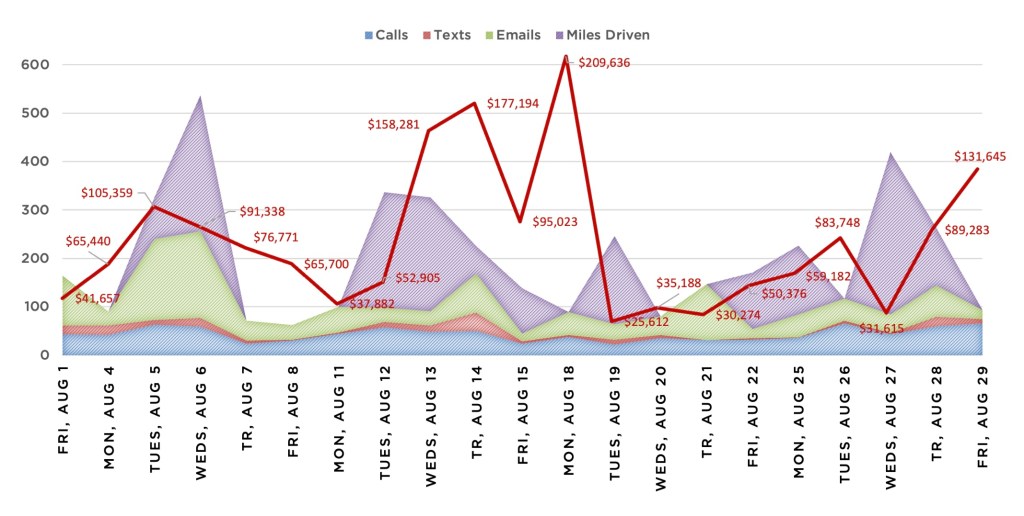
Great whites must keep swimming to breathe. Quint must keep communicating to sell. Over 21 sales days, he logged 2,340 interactions—1,003 calls, 1,128 emails, and 209 texts—and drove 1,887 miles on 11 planned travel days. High-frequency touchpoints keep him top of mind, surface problems early, and maintain deal momentum. Proactive communication today prevents expensive problems tomorrow.
Notably, more than 55 percent of his communication was internal with his inside sales team—an area he’s now investigating to reclaim more customer-facing time.
2. Concentration Beats Coverage
Great whites aren’t indiscriminate omnivores; they’re selective predators. Quint is selective too. He manages just 17 accounts, allowing him to dive deep with each one. During the month, he spent 55 hours auditing takeoffs for his top customer. “Some reps might say that’s not my job,” Quint said. “And per the scope, it’s not. But when I go above and beyond like this, there’s no price negotiation later.”
Fewer accounts create deeper wallet share, stronger loyalty, and higher revenue per relationship. Quint knows this level of focus is impossible with 50 or 75 accounts.
3. Responsiveness Compounds
Great whites detect microscopic vibrations in the environment. Quint does the same. During our study, four new accounts appeared via referral, worth more than $250,000 in near-term revenue and potentially $5 million over the next twelve months. None were active prospects. All were dividends from past responsiveness, situations when Quint made someone else look good.

4. Show Up When There’s Blood in the Water
A great white can sense a single drop of blood from a mile away—and then it acts immediately. When deals are at risk, Quint doesn’t send emails or hope customer service handles it. He gets in his truck.
Account management activities (versus sales-generating ones) consumed 43 percent of his time. This can be called inefficient. His customers call it trust. One builder emailed a competitor, CC’d Quint, and wrote: “You’re cheaper, but Quint’s my guy.”
5. Built for the Long Hunt
Sharks can live up to 70 years. Quint plays the long game too. He stays competitive but refuses to race to the bottom. “This market won’t last forever,” he said. “The guy who’s 30 percent cheaper can’t sustain that price—but I can sustain my value.”
Throughout the study, Quint consistently credited his operations team, drivers, purchasing, and inside sales. Apex predators only thrive in healthy ecosystems. Quint understands that.
If you want better sales hunters, stop watching from shore. Enlist your best reps in understanding themselves.
Measure behavior.
Interpret patterns.
If we can tag a shark, you can too—and you’ll understand how to develop more of them.
To receive the Tagging A Shark field study report upon completion, register here.
| Thanks for reading. I’ll see you back here next Thursday. |

Subscribe here to get the next edition of The Craft of LBM Sales straight to your inbox—weekly stories and practical advice to master the craft of selling.

Sharks don’t drift. They move with purpose
The Weekly Game Plan helps LBM sales pros turn reactive selling into intentional execution.
Save $50 with code
NEWSLETTER50 by Feb 20 at midnight.
Copyright © 2026
Bradley Hartmann & Co.
All rights reserved.

Contact Bradley Hartmann:
bradley@bradleyhartmannandco.com
 The Craft of LBM Sales