

The 5-Tool Salesperson
On Sunday and Monday of this week, Major League Baseball(MLB) held its annual draft. Across 20 rounds, 615 high school and college players were selected.
MLB scouts have spent months—and in many cases, years—evaluating these athletes. To assess their strengths and project their potential, scouts rely on a standardized 20–80 grading scale across five key skills.
A score of 50 represents a league-average Major Leaguer.
The scale gives scouts two scores per skill:
- Present Value (current performance)
- Future Value (projected performance)
For example, a scout might rate Eli Willits —the 17-year-old Oklahoma shortstop taken #1 overall by the Washington Nationals — like this:
Present: 55 / Future: 60
We all have potential.
A scout’s job is to quantify it.

Scouts apply this scale to the “5 Tools” of baseball talent:
- Hit for Average – Does he make consistent contact?
- Hit for Power – Does he hit home runs?
- Run – Is he fast?
- Arm – Is it strong and accurate?
- Field – Does he defend well?
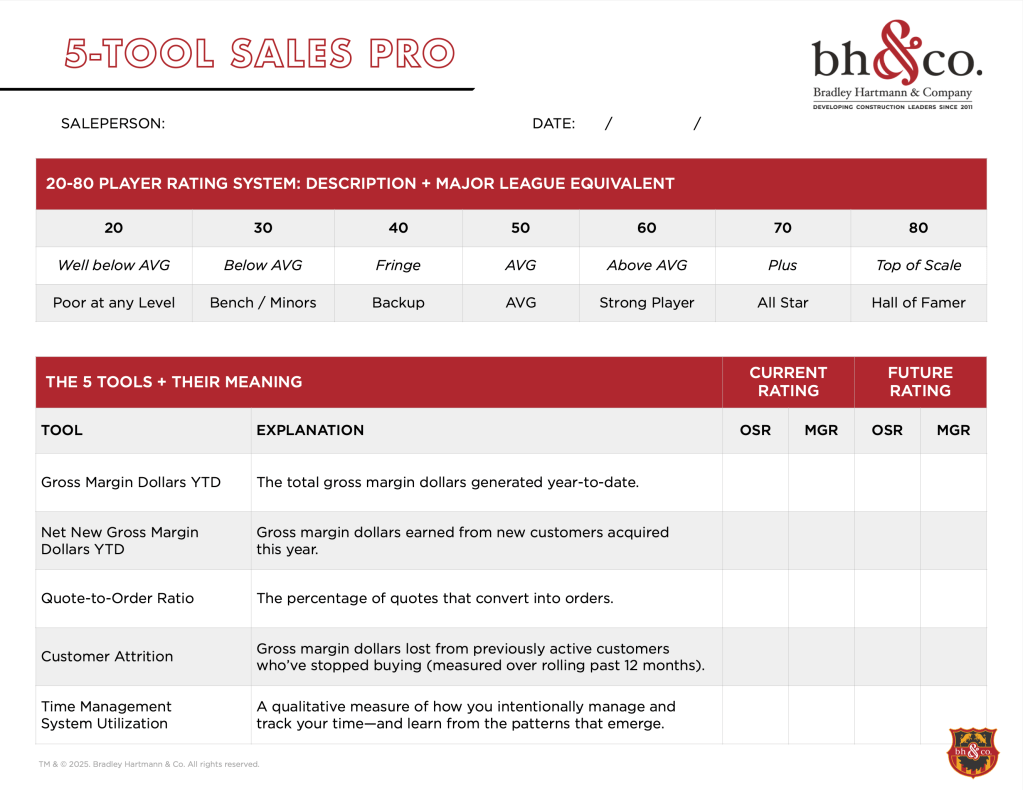
| What Are the 5 Tools of Sales? While watching the first round of the draft with my family, I thought about the talent we’re often hired to evaluate: salespeople like you. So, what would the 5-tool grading system look like for sales? Here’s what I came up with: 1. Gross Margin Dollars YTD What it is: The total gross margin dollars generated year-to-date. Why it matters: It reflects your financial contribution to overall profitability. |
| 2. Net New Gross Margin Dollars YTD What it is: Gross margin dollars earned from new customers acquired this year. Why it matters: Salespeople sell—converting non-customers to customers and selling existing customers new product categories. If you want to babysit your best customers and hope they build more, that’s okay, but you’ll need a title change: account manager. |
| 3. Quote-to-Order Ratio What it is: The percentage of quotes that convert into orders. Why it matters: This is an efficiency metric. Too high of a ratio and it may mean you’re not pursuing enough prospects; too low of a ratio signals a lot of wasted effort. |
| 4. Customer Attrition What it is: Gross margin dollars lost from previously active customers who’ve stopped buying (measured over rolling past 12 months). Why it matters: Attrition happens, especially when we’re not tracking it. All Stars don’t just land accounts, they grow and retain them. |
| 5. Time Management System Utilization What it is: A qualitative measure of how you intentionally manage and track your time—and learn from the patterns that emerge. Key questions:Do you have a visible, working system?Do you use it daily and update it regularly?Are your daily tasks aligned with your goals?Why it matters: “Find something that works for you,” is the LBM industry’s default recommendation for sales reps—and most never do. You can always make more money, but you can’t make more time. All Stars manage their time with discipline and thoughtfulness. |
Evaluating yourself—with both candor and kindness—is critical to mastering your craft.
Here’s how to do it:
- Download the PDF using the button below.
- Score yourself on each of the 5 sales tools—current and projected.
- Share it with your manager and ask them to do the same.
Then, have a conversation:
- Do you both see reality the same way?
- What can you do to improve over the next 30 days?
- Are there key metrics you’re not tracking today?
- Which single skill or metric will you prioritize for growth?
You might be wondering: Why do scouts use a scale that starts at 20 and ends at 80?
Well, the 20–80 scale isn’t linear, it’s logarithmic, which is a fancy way to say the jump from 50 to 60 isn’t the same as the jump from 60 to 70. Each level up is increasingly difficult which means there are fewer scores of 60, 70, and 80.
- 50 = Average (Most players)
- 70 = All-Star (Just 5.2% of all players ever)
- 80 = Hall of Fame caliber (Less than 1.5% of all players, ever)
As you evaluate yourself, keep this in mind: The higher you go, the harder it gets.
Yes, confidence matters.
But in sales, like in baseball, self-deception is the enemy.
Average isn’t bad.
But average doesn’t win championships.
Thanks for reading.
I’ll be back next Thursday.

Subscribe here to get the next edition of The Craft of LBM Sales straight to your inbox—weekly stories and practical advice to master the craft of selling.
Copyright ©2025
Bradley Hartmann & Co.
All rights reserved.

Contact Bradley Hartmann:
bradley@bradleyhartmannandco.com
 The Craft of LBM Sales